12/17/2025
The Principal Motifs of Champa Sculpture
The principal decorative motifs of Champa sculpture, from the chrysanthemum and lotus to the wave and geometric patterns.
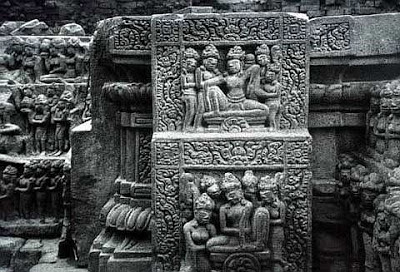
Along Vietnam's central coast, Cham towers have stood for nearly a millennium, testifying to a rich and distinctive Champa culture that blended indigenous tradition with influences absorbed through maritime trade. The Museum of Cham Sculpture in Da Nang — home to more than 2,000 artifacts spanning the 8th to 15th centuries — preserves the clearest record of Champa's characteristic decorative motifs.
The chrysanthemum motif is among the earliest, dating to the 7th–8th centuries and best seen on the altars of My Son E1: four petals gathered symmetrically around a central pistil, carved with great precision. The lotus motif appears across many later artistic periods, from Hindu temples to the Dong Duong Buddhist monastery, portrayed in images such as Brahma seated on a lotus throne or the dancer pedestals of Tra Kieu.
The vine-flower motif — an unbroken scroll of leaves and blossoms running from the tower body down to its base — is especially prominent at the Khuong My towers, while the so-called "caterpillar" motif, characteristic of the 9th-century Dong Duong style, is dense and intricate, clearly distinguishing it from the My Son style. At the Mam tower (12th–14th centuries), a wave-or-flame motif interspersed with images of the deity Kala and the monkey-god Hanuman takes on a bolder, more forceful character.
Alongside geometric border patterns, terracotta cult statues depicting deities such as Lakshmi (goddess of fortune and happiness), Kala (god of time, a symbol of destruction), and the Makara head (a symbol of favorable rains) each carry their own symbolic meaning, reflecting the blending of indigenous belief with Hindu and Buddhist tradition.
Across its many stylistic periods, Champa sculpture retained a character all its own, unmatched by any other civilization in the region — a lasting testament to the skill and creative intelligence of the ancient Cham people.